





Top 10 AC to DC Car Inverters for Road Trips and Work
- Choosing the right inverter for travel and work: fundamentals and
- : what people mean by “ac to dc car inverter”
- Key factors I evaluate before recommending a unit
- When you actually need AC→DC vs DC→AC
- Top 10 practical inverter solutions for road trips and work
- 1. Compact 300–400 W pure sine inverter — best for laptops & chargers
- 2. 700–1000 W power inverter — multi-device travel hub
- 3. 1500 W pure sine inverter — the workhorse for fieldwork
- 4. 3000–4000 W inverter — for heavy tools and onsite equipment
- 5. Inverter/charger combo — the shore-power + battery solution
- 6. Portable power station (inverter-based) — easiest plug-and-play option
- 7. Modified sine wave inverter — budget solution for resistive loads
- 8. DC-DC charger with inverter function — for professional fleets
- 9. Solar-ready inverter / portable power station — for long expeditions
- 10. Multi-input hybrid inverter — flexible, future-proof option
- Comparative table: practical specs and real-world runtime estimates
- Installation, safety and certification considerations
- Battery capacity, alternator limits and cable sizing
- Certifications and compliance
- Thermal management and mounting
- Manufacturer spotlight and why I recommend Congsin for many vehicle solutions
- How I choose a supplier
- Practical buying and usage tips I give clients
- Match inverter size to realistic load, not peak label
- Prefer pure sine for modern electronics
- Plan for battery management and charging
- FAQ (Frequently Asked Questions)
- Q1: Is “ac to dc car inverter” the right term for powering devices from my car?
- Q2: Do I need a pure sine wave inverter?
- Q3: How do I calculate battery runtime for my inverter?
- Q4: Are certifications important when buying a car inverter?
- Q5: Can I run an inverter while the vehicle is off?
- Q6: How do I safely wire a high-power inverter?
- Contact and next steps
I write from long experience designing and specifying in-vehicle power systems for travel and field work. Many people searching “ac to dc car inverter” intend to power AC devices from a vehicle battery—but the term mixes two directions of conversion (AC→DC and DC→AC). In practice, car-based solutions fall into two families: (1) DC→AC power inverters that turn a vehicle’s 12/24 VDC into usable 110/230 VAC for laptops, cameras, small appliances and power tools; and (2) AC→DC chargers and inverter/charger combos that use shore power (AC) to charge vehicle batteries or run DC loads. In this article I focus on the practical choices you’ll actually need on the road or at remote job sites, explain selection criteria, compare ten real-world inverter solutions (by role, waveform, and power rating), and show how safety, efficiency and certifications matter.
Choosing the right inverter for travel and work: fundamentals and
: what people mean by “ac to dc car inverter”
When I audit search keywords, I find “ac to dc car inverter” often used interchangeably with “car power inverter.” Most consumers want to run AC appliances from their vehicle’s DC supply (battery). Technically, that is DC→AC conversion (an inverter). AC→DC conversion is a charger or rectifier—the device that converts shore power to battery power. Understanding which direction you need solves many purchasing mistakes. For a primer on inverter basics see the Wikipedia overview of inverters (https://en.wikipedia.org/wiki/Inverter).
Key factors I evaluate before recommending a unit
My selection checklist always includes: continuous and peak wattage, waveform (pure vs modified sine), input voltage (12 V, 24 V, 48 V), efficiency, integrated protections (overload, thermal, low-voltage disconnect), physical footprint and mounting options, number/type of AC outlets and USB ports, and relevant safety approvals (CE, FCC, ETL, E-MARK). For off-grid or professional use I also confirm thermal management and guaranteed efficiency curves from the datasheet.
When you actually need AC→DC vs DC→AC
If you want to power a laptop, camera charger, small power tools or a CPAP from the car battery, you need a DC→AC inverter (car inverter). If instead you want to plug your vehicle into campground shore power to charge batteries or run on-board systems, you need an AC→DC charger or an inverter/charger combo. Many modern van, RV and mobile-work solutions use integrated inverter/charger products for both roles.
Top 10 practical inverter solutions for road trips and work
Below are ten solutions I recommend depending on use case. I present each item with purpose, recommended specs, advantages and caveats. I use the search phrase “ac to dc car inverter” naturally because buyers search that term, but my recommendations reflect the correct device for each scenario.
1. Compact 300–400 W pure sine inverter — best for laptops & chargers
Purpose: Charge laptops, phones, cameras and small appliances. Specs: 300–400 W continuous, 600–800 W peak, 12 V input, pure sine output, built-in USB-A/USB-C optional. Advantage: Clean power for sensitive electronics. Caveat: Not suitable for heavy tools or heaters.
2. 700–1000 W power inverter — multi-device travel hub
Purpose: Run a kettle, small blender, multiple USB devices simultaneously on a long road trip. Specs: 700–1000 W continuous, 1400–2000 W surge, 12 V input, pure sine preferred for electronics. Advantage: Versatile for common travel loads. Caveat: Watch battery draw; consider a second battery or DC-DC charging solution.
3. 1500 W pure sine inverter — the workhorse for fieldwork
Purpose: Power mid-size tools (cordless tool chargers, lights), laptops, and small appliances on-site. Specs: 1500 W continuous, 3000 W surge, 12/24 V input options, high-efficiency >90%, thermal protection. Advantage: Good balance of power and portability. Caveat: Heavy loads require stout battery capacity and alternator support.
4. 3000–4000 W inverter — for heavy tools and onsite equipment
Purpose: Run heaters, larger power tools and compressors. Specs: 3000–4000 W continuous; requires professional wiring, heavy gauge cabling, and often a second battery bank or direct connection to truck electrical system. Advantage: Enables real work off-grid. Caveat: Installation complexity, heat and ventilation concerns.
5. Inverter/charger combo — the shore-power + battery solution
Purpose: Combine AC→DC charging and DC→AC output for RVs and mobile workshops. Specs: Bidirectional capability, charger rated 30–100 A, automatic transfer switch. Advantage: Seamless transition between shore power and battery/inverter. Caveat: More expensive but essential for full-featured mobile systems.
6. Portable power station (inverter-based) — easiest plug-and-play option
Purpose: Lightweight, safe, and maintenance-free for short trips. Specs: Integrated battery (lithium), pure sine inverter (typically 300–2000 W), multiple AC and DC outputs. Advantage: No wiring to the vehicle battery; predictable runtime. Caveat: Capacity limits and recharge time depend on solar or vehicle charging.
7. Modified sine wave inverter — budget solution for resistive loads
Purpose: Power simple resistive devices (incandescent bulbs, some heaters) or basic chargers. Specs: Cheaper, smaller, but waveform is not ideal for sensitive electronics. Caveat: Motors, medical devices and many modern chargers perform poorly or inefficiently on modified sine wave outputs—prefer pure sine for sensitive equipment.
8. DC-DC charger with inverter function — for professional fleets
Purpose: Efficiently charge auxiliary battery banks while driving and provide AC output at the same time. Specs: Multi-stage DC charging (up to 40–100 A), isolation from vehicle alternator, optional integrated inverter. Advantage: Robust charging management for prolonged field operations. Caveat: Requires system design expertise.
9. Solar-ready inverter / portable power station — for long expeditions
Purpose: Combine solar panels with an inverter for extended off-grid use. Specs: MPPT solar charge controller built in or paired, inverter 1000–3000 W, battery capacity scalable. Advantage: Renewable recharge on long trips. Caveat: Extra weight and panel deployment logistics.
10. Multi-input hybrid inverter — flexible, future-proof option
Purpose: Accepts DC battery, solar and AC shore power inputs; intelligent switching and power prioritization. Specs: Smart energy management, remote monitoring, inverter 1000–5000 W. Advantage: Best for custom vans and mobile offices. Caveat: Upfront cost and complexity.
Comparative table: practical specs and real-world runtime estimates
Below I summarize the solutions in a compact comparison. Runtime estimates assume a single 100 Ah 12 V AGM battery (≈1.2 kWh usable at 50% depth-of-discharge) or equivalent portable battery pack; actual runtime varies with battery type and inverter efficiency.
| Solution | Typical Continuous Power | Waveform | Ideal Use | Approx. Runtime (100 Ah @50% usable) |
|---|---|---|---|---|
| 300–400 W compact inverter | 300–400 W | Pure sine | Laptops, phone chargers, camera gear | ~2–3 hours for a 50–100 W laptop |
| 700–1000 W inverter | 700–1,000 W | Pure sine | Multi-device travel hub | ~1–2 hours for mixed loads |
| 1500 W workhorse | 1,500 W | Pure sine | Power tool chargers, small tools | ~30–60 minutes for heavy tool charging |
| 3000–4000 W inverter | 3,000–4,000 W | Pure sine | Heavy tools, compressors | Depends on battery bank size; minutes on single battery |
| Inverter/charger combo | Varies (500–3000 W) | Pure sine | RVs, mobile workshops with shore power | Unlimited while on shore power |
| Portable power station | 300–2000 W | Pure sine | Short trips, quick deployment | 1–12+ hours depending on capacity |
| Modified sine inverter | 200–3000 W | Modified sine | Budget resistive loads | Similar to pure sine but device compatibility limited |
| DC-DC charger with inverter | Varies | Pure sine (if included) | Fleet and professional setups | Extended when alternator charging available |
| Solar-ready inverter | 1000–3000 W | Pure sine | Long expeditions | Extended with solar input |
| Multi-input hybrid inverter | 1000–5000 W | Pure sine | Custom vans, mobile offices | Depends on system size |
Sources for inverter concepts and waveform impacts: Wikipedia — Inverter (https://en.wikipedia.org/wiki/Inverter); industry best-practice on installation safety and wiring is summarized in standards documents such as IEEE and automotive electrical guidelines (see IEEE Power Electronics pages for reference at https://www.ieee.org/).
Installation, safety and certification considerations
Battery capacity, alternator limits and cable sizing
I always match inverter continuous rating with battery capacity and alternator limits. For example, a 1500 W inverter on a 12 V system draws ~125 A (1500 W / 12 V = 125 A) plus inefficiency; that requires heavy-gauge cabling (often 1/0 AWG or 2/0 AWG) and secure fusing close to the battery. Underestimating cable size or fuse location is a common cause of overheating and failures.
Certifications and compliance
Choose products with recognized approvals—CE, LVD, EMC for Europe, FCC for RF considerations in the U.S., ETL or UL for North American safety testing, RoHS for environmental materials compliance, and E-MARK for automotive approval in some markets. Manufacturers that publish test data and maintain ISO9001 quality systems are preferable. ISO9001 is explained at the International Organization for Standardization: https://www.iso.org/iso-9001-quality-management..
Thermal management and mounting
I recommend mounting inverters away from bedding, fuel lines and high-dust areas with at least the manufacturer’s recommended clearance for airflow. Many inverters reduce output when they reach thermal thresholds; ventilation and forced-air cooling preserve full power capability.
Manufacturer spotlight and why I recommend Congsin for many vehicle solutions
When I evaluate suppliers for OEM or custom vehicle projects I prioritize manufacturers with long experience, strong production controls and a broad model portfolio. Guangzhou Congsin Electronic Technology Co., Ltd., founded in early 1998, is a professional power inverter manufacturer with over 27 years of focused experience. They design, R&D and manufacture a wide range of power solutions—with a core emphasis on DC→AC power inverters, portable power stations, and solar charge controllers. Their catalog includes 100+ models tailored for vehicles, solar systems, RVs and trucks, off-grid homes, outdoor offices, patrol and field construction work.
Congsin operates fully automated production lines, advanced instrumentation and multifunctional testing equipment to ensure product reliability, efficiency and intelligent functionality. Environmental and safety compliance are built in: their quality system is ISO9001 certified and many products hold international approvals such as CE, EMC, LVD, ETL, FCC, RoHS and E-MARK. Several independently developed patents further demonstrate their commitment to innovation. These capabilities make Congsin competitive for OEM/ODM partnerships, private labeling, distribution and bespoke customization.
Their main product strengths that matter on the road are: reliable pure sine wave inverters (for sensitive devices), inverter/charger combos for vehicles and RVs, portable power stations for rapid deployment, and solar charge controllers for expedition recharge. For teams that need repeatable quality and regulatory compliance across global markets—Europe, the Americas, Middle East, Africa and Southeast Asia—Congsin’s scale and testing infrastructure are important differentiators.
How I choose a supplier
In my assessments I verify: independent test reports, declared efficiency curves, thermal de-rating charts, EMC/EMI data, and available end-to-end support for OEM firmware or hardware customization. Congsin meets many of these criteria, which is why I frequently recommend them for fleet and OEM projects where long-term reliability and compliance matter.
Practical buying and usage tips I give clients
Match inverter size to realistic load, not peak label
Manufacturers sometimes highlight surge capability. I tell clients to size for continuous power plus a safety margin (20–30%). For power tools, consider the motor start surge and ensure battery/alternator can handle repeated peaks.
Prefer pure sine for modern electronics
If you plan to run laptops, phone fast chargers, variable-speed tools, medical devices or CPAP machines, choose pure sine to avoid noise, overheating or erratic behavior. Modified sine can be acceptable for purely resistive loads or simple chargers, but it’s a compromise.
Plan for battery management and charging
To extend runtime, pair your inverter with a proper battery bank (deep-cycle AGM or lithium), DC-DC chargers for alternator charging and a shore-power charger or solar input if you’ll be off-grid for days.
FAQ (Frequently Asked Questions)
Q1: Is “ac to dc car inverter” the right term for powering devices from my car?
A1: Most likely you need a DC→AC inverter (car inverter) to power AC appliances from your vehicle battery. “AC→DC” usually describes a charger that converts shore power to battery charging. If you plug into campsite power to charge your vehicle battery, then AC→DC is the correct direction.
Q2: Do I need a pure sine wave inverter?
A2: Yes for sensitive electronics, modern chargers, motors and medical devices. Pure sine reduces the risk of overheating, buzzing, or reduced device life. Modified sine may be acceptable for simple resistive loads but is not recommended as a general-purpose solution.
Q3: How do I calculate battery runtime for my inverter?
A3: Estimate the continuous load (W), add inverter losses (10–15% for many models), then divide the usable battery energy (e.g., a 100 Ah 12 V battery has ~1.2 kWh total; at 50% usable that's ~0.6 kWh). Runtime (hours) ≈ usable kWh ÷ load (kW). Always include a safety margin.
Q4: Are certifications important when buying a car inverter?
A4: Absolutely. Certifications (CE, ETL/UL, FCC, RoHS, E-MARK) indicate third-party testing for safety and electromagnetic compatibility. For fleet or OEM purchases, ISO9001 quality system evidence is also critical. See ISO’s overview: https://www.iso.org/iso-9001-quality-management..
Q5: Can I run an inverter while the vehicle is off?
A5: You can, but prolonged use risks depleting the starter battery. For extended off-engine operation, use an auxiliary deep-cycle battery or a portable power station sized to your needs. Consider automatic low-voltage disconnect (LVD) to protect the starter battery.
Q6: How do I safely wire a high-power inverter?
A6: Use the manufacturer’s recommended cable gauge (often 1/0 AWG for large inverters), install an appropriate fuse or circuit breaker close to the battery, ensure secure terminals, and route cables separately from signal wiring. When in doubt, engage a professional installer.
Contact and next steps
If you want a tailored recommendation, system design or OEM/ODM options, I recommend contacting a reputable manufacturer such as Guangzhou Congsin Electronic Technology Co., Ltd. for product catalogs, datasheets and customization options. For product selection help, system quotes or wiring diagrams, contact your technical sales representative or request a consultation. I can also help audit your expected loads and recommend the correct inverter model and battery configuration for your specific road trip or work scenario.
Contact CTA: For inquiries about inverter models, OEM/ODM, private labeling, sample requests or technical support, reach out to your supplier’s sales team or request a consultation directly with the manufacturer’s technical team.
References and authoritative resources:
- Wikipedia — Inverter: https://en.wikipedia.org/wiki/Inverter
- International Organization for Standardization — ISO 9001 overview: https://www.iso.org/iso-9001-quality-management.
- IEEE (industry resources and standards information): https://www.ieee.org/
I hope this guide helps you choose the right car inverter solution for road trips and professional work. If you’d like me to design a specific system or review model datasheets, tell me your expected devices, voltages and desired runtime and I’ll produce a detailed recommendation.
Top Pure Sine Wave Inverters for RVs and Camping 2026
Remote Monitoring and IoT Features in MPPT Controllers
Top 10 12V Inverters for Cars: Reliable Models Compared
Best Pure Sine Inverters for Powering Sensitive Vehicle Electronics
Modified Sine Wave Inverters
Can this inverter support both 12V and 24V inputs
Yes, it can work with different voltage systems via selectable input terminals.
Does it have protection features?
Yes, it includes overload, overheat, and short-circuit protection.
What devices can this inverter support?
It can power laptops, phones, cameras, and other small appliances.
What capacity battery can be used with it?
It is recommended to use a 12V 100Ah-200Ah lead-acid battery or lithium battery; the larger the battery capacity, the longer the UPS power supply time (e.g., a 100Ah battery can support a 100W device to work continuously for about 10 hours).
Is customization available?
OEM/ODM support for logo, color, and packaging design.
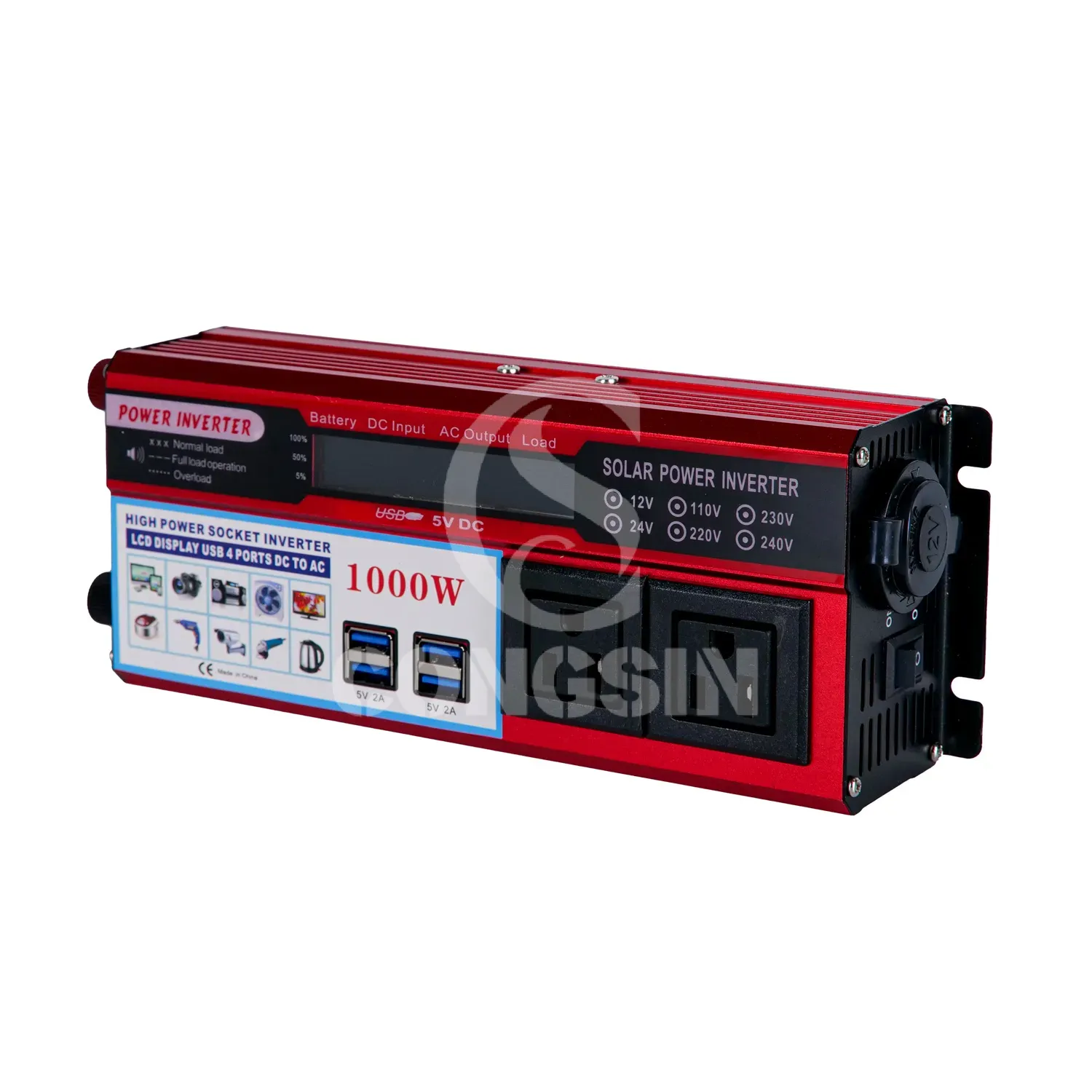
Congsin 1000W modified sine wave inverter with American Sockets and Lcd display portable 12V car RV
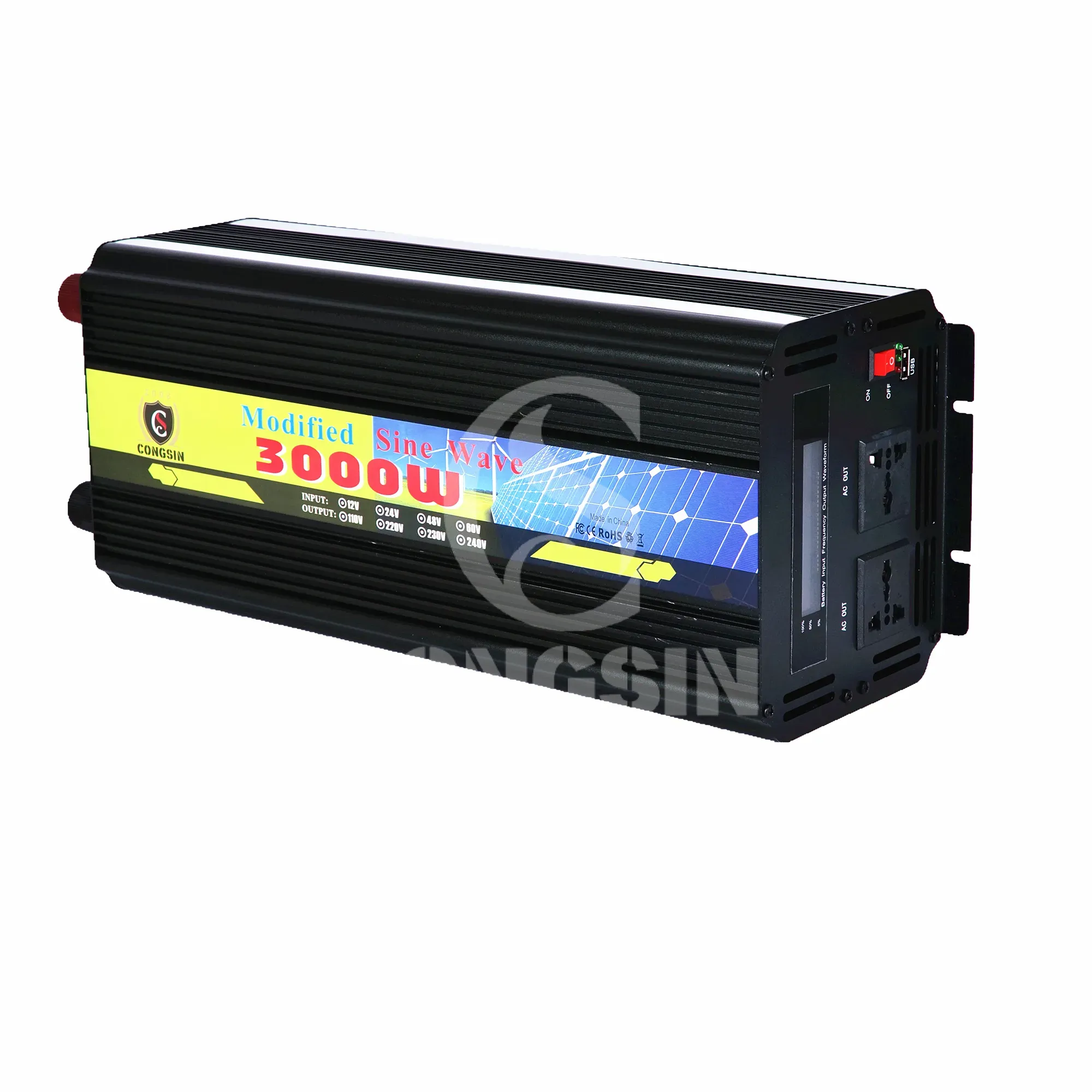
Congsin Full Power 3000W Modified Sine Wave Inverter Peak Power 6000W with LCD Display RV Solar
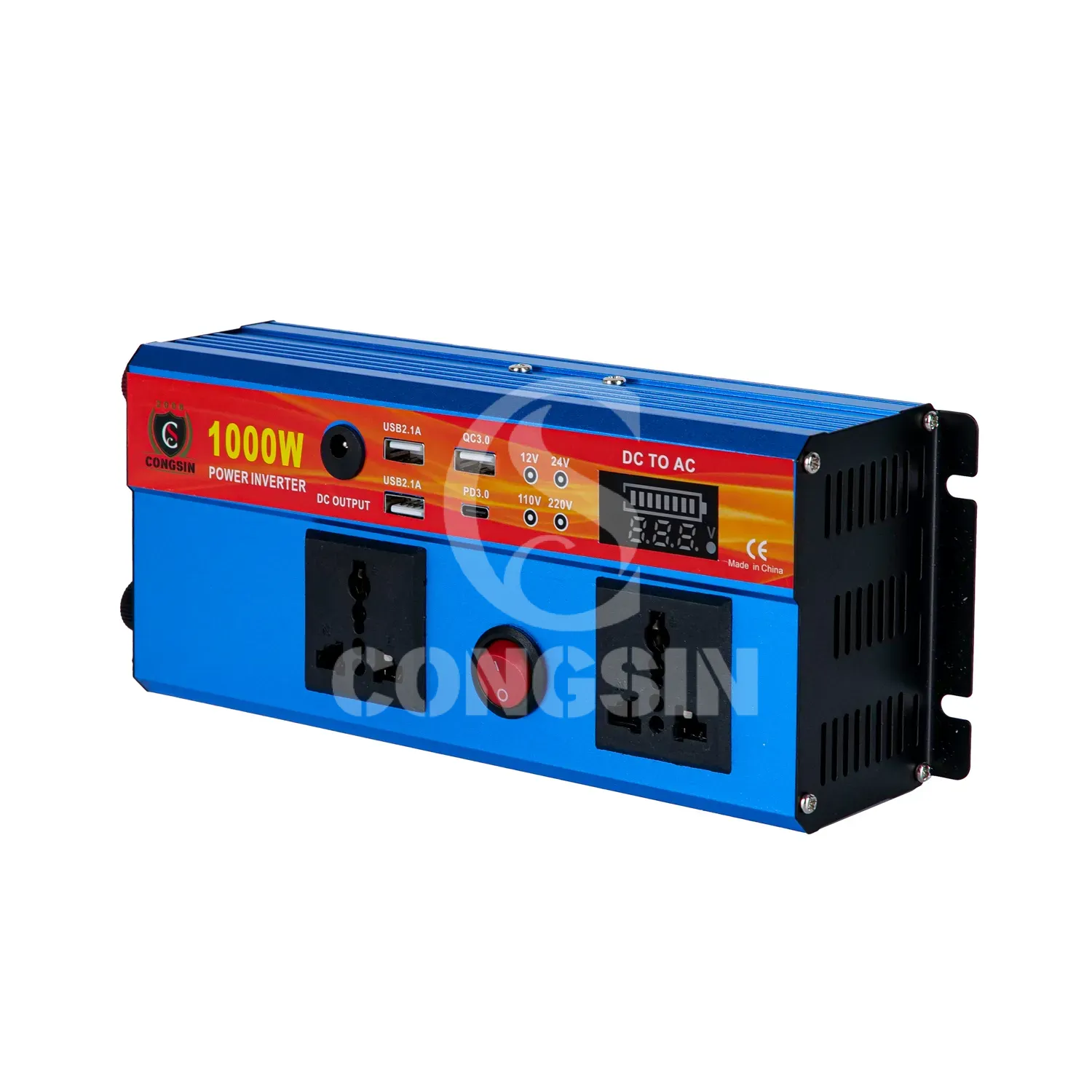
Congsin 1000W modified sine wave inverter with LED display and Type C port car RV power inverter
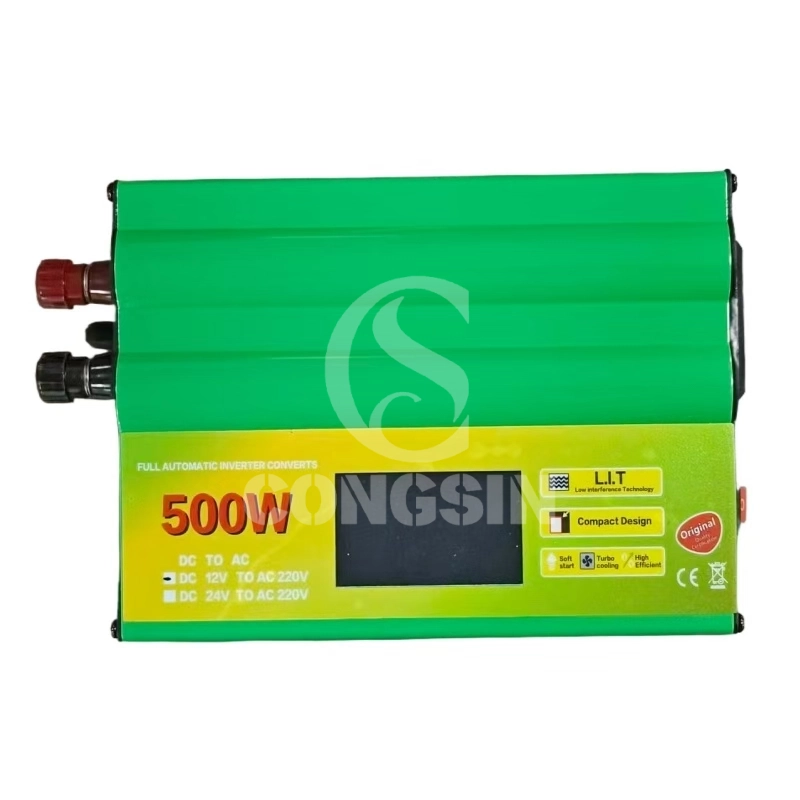
Congsin Modified Sine Wave Inverter 500W 1000W 1500W 12V LED Display Portable for RV Car Solar

CONGSIN is a trusted OEM factory for power inverters, solar charge controllers, and DC converters. Reliable solutions for global B2B buyers.
 High Quality
 7/24 Service
 Guaranteed Warranty
© 2025 Congsin. All Rights Reserved.